What can you expect?
Of course, there are no entry requirements other than a stable state of health. Why is that? Surveys confirm this: More and more sportspeople appreciate being able to consciously enjoy relaxation and meditation in addition to the physical exertion of sporting competition, e.g. football, basketball or tennis (to name just a few of the 20 sports at Team Munich). This relaxation in turn promotes motivation and willingness to perform in active, physically demanding sports and releases energy that can be successfully utilised in competition.
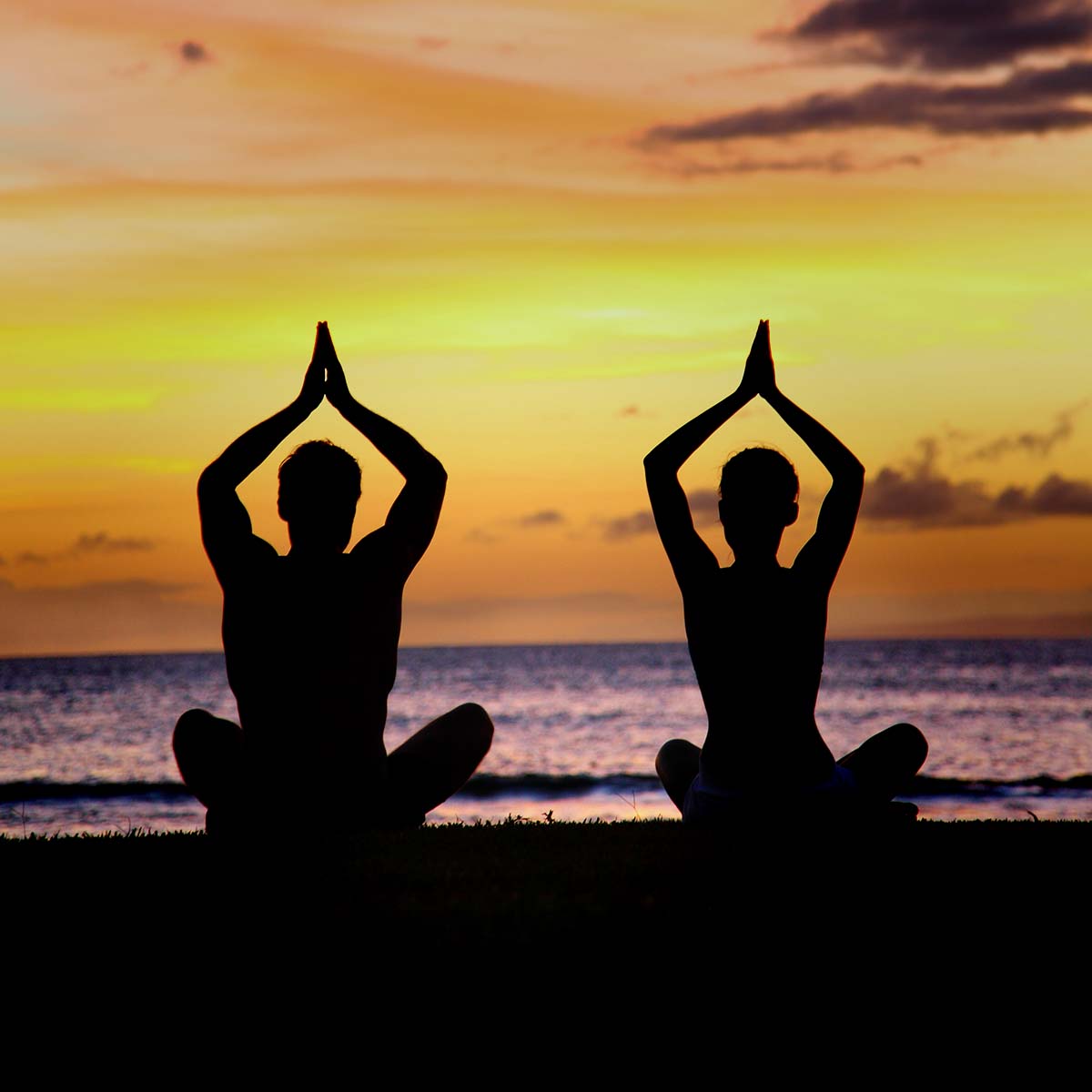
Yoga can also be quite strenuous, depending on how the participants approach it. We start our yoga course with pure relaxation. For us holistically orientated people, this naturally involves all three areas - body, mind and psyche. This is followed by the breathing exercise with conscious and deep inhalation and exhalation, because breathing connects us rhythmically with our surroundings, as our yoga teacher Maximilian never forgets to emphasise. The initial relaxation and breathing exercise together last around 30 minutes.
And then it starts: now it's the body's turn, although breathing is of course always observed and emphasised.
Physical exercises in yoga are called asanas and are also organised systematically. Static exercises such as the boat on the stomach and on the back as well as the shoulder stand (also known as the candle) are followed by dynamic exercises such as the twisting exercises while standing. It is important that we never practise one-sided exercises, but rather follow a forward bend with a backward bend, i.e. practise balancing exercises. The same naturally applies to sideways exercises, always to both sides. And then there are asanas with a series of body movements in sequence, e.g. the cat variations or the sun salutation. All asanas have names that do not always have anything to do with the exercise itself, but help regular participants to familiarise themselves with the sequence of the yoga class. The asanas are always interspersed with relaxation, according to the basic yogic principle of rhythm: tension follows relaxation, then tension again, and so on.
Maximilian emphasises emphatically: "Yoga is also an exercise in slowing down. It's never about going faster, higher, further. Rather in connection with breathing, as slowly, concentrated and mindful as possible". He does not consider yoga paths that focus on performance, such as sports yoga or power yoga, to be yoga in the original sense. This body-centred part of the yoga course lasts around 45 minutes.
A yoga class ends with a 15-minute meditative final relaxation: this is usually introduced with a text meditation and accompanied by relaxing music.
What kind of yoga does Maximilian offer?
That is not easy to answer. It integrates elements of different yoga paths that Maximilian learnt during his three-year yoga teacher training course almost 25 years ago and has since developed further. Hatha yoga, Kundalini yoga, Raja yoga, etc. „I now call it integral yoga,“ says our yoga teacher about this yoga programme. „Yoga for athletes“ is a yoga path that Maximilian has recently focussed on in particular. „It's not about sports yoga“, he emphasises, but about finding a way „back to balance“. He quotes Erin Taylor in her book YOGA FOR SPORTSPEOPLE, published by riva-Verlag. Erin Taylor writes in the introduction: „We are made to be in balance. Logically, this is when we perform at our best. A balance of right and left, up and down, front and back - work and rest - protects against injury, enhances performance and optimises any form of fitness. It helps to achieve performance goals and maximises potential. In the end, it is up to us to constantly redefine the balance at the interface between strength and flexibility, effort and ease - so that it helps us to achieve our individual goals.“




 English (UK)